 SENSION - ST. JOHN
 4,
4,whose descendants represent the American ST. JOHN line
 St. John surname origin: English
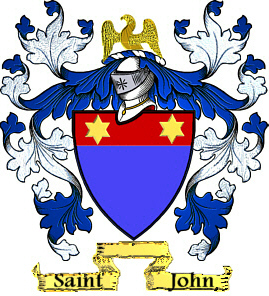
Coat of Arms
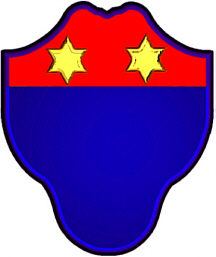
Blue shield with a red bar at the top two gold stars
Bar = One who sets the bar of conscience, religion, and honour
against angry passions and evil temptations
Mullet (Star) = Divine quality from above; mark of third son,
Star = (estoile or mullet) Celestial goodness; noble person
Gold = Generosity and elevation of the mind
Red (Gules) Warrior or martyr; Military strength and magnanimity
Blue (Azure) Truth and loyalty
Crest: A falcon
Falcon = One who does not rest until objective is achieved
Motto: Data fata secutus
Motto Translated: "Following my destiny"
Sension surname origin: unknown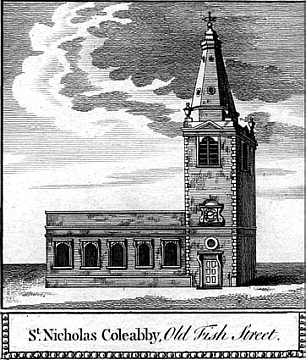
| St. John Family Motto "I will live for those who love me, For those who know me true; For the Heaven that smiles above me; And waits my coming, too; For the cause that needs assistance, For the wrong that needs resistance, For the future in the distance, And the good that I can do." From the St. John Family Reunion records of 1882 |
The History of St. Nicholas Cole Abbey, where Thomas & Mark Sension were baptized - sons of Matthias & Mary Sension.
In the year 1666 the old church was destroyed in the Great London Fire, but was rebuilt 1671-1681.
In the year 1666 the old church was destroyed in the Great London Fire, but was rebuilt 1671-1681.
"The name Cole Abbey is generally thought to be a
corruption of “Cold Harbour”, a medieval type of lodging house
for travelers which most likely was located close to the church. In
the Victorian era it was sometimes called St Nicholas Cole Hole Abbey
because the smoke from steam engines in the newly built
underground came through a vent and blackened the building. Dedicated
to St Nicholas, the fourth century Bishop of Myra in Asia Minor who
became the patron saint of travelers and seamen, St Nicholas Cole
Abbey is first mentioned in a letter of Pope Lucius II in 1144 and is
considered to have been founded in that year . From the late 13th
century the church is recorded as St Nicholas-behind-Fish Street and is
clearly associated with the fish trade. A fish market existed in this
part of London well before Billingsgate Market was founded; with the
development of the fish trade during the reign of Richard I, a fish
market was established near the church and fishmongers in the 16th
century were buried in the church’s burial ground. During the reign of
Elizabeth I, a lead and stone cistern fed by lead pipes from the Thames
was set up against the north wall of the church; it was donated by a
wealthy fishmonger who gave £900 “to bring Thames water (…) for
the care and commodity of the fishmongers in and about Old Fish Street.”
Until the Reformation the church had three chantries served by three
chantry priests, and, as it was dedicated to St Nicholas, it preserved
the tradition of a boy bishop officiating on the Feast of St Nicholas.
With the reintroduction of Catholicism in England under Mary, following
the reign of Edward VI, St Nicholas Cole Abbey was the first church in
which the Mass was celebrated in Latin once again with a cross s and candles on the altar. A century later, however, the church passed into
the patronage of the Puritan Colonel Hacker who commanded the guard at
the execution of Charles I. A devastating event in the life of St
Nicholas Cole Abbey was the Great Fire of London in 1666 when it was
burned down." Source: http://www.culham.ac.uk/coleabbey/assets/pdf/nc_building1.pdf
No one really knows how long the ancestors of the Sension family lived
in England before coming to America. Matthias Sension and his wife,
Mary Tinker Sension, left London from the vicinity of St. Nicholas Cole Abbey,
and came to New England sometime
between June 10, 1633 and September 3, 1634. Records show that this
family was still living in London on June 10, 1633, this from baptismal
entries for their son, Marke, at St. Nicholas Cole Abbey. Matthias
Sension was made a Freeman on September 3, 1634 at Dorchester,
Massachusetts, and we would like to imagine that Mary Sension did not
set sail until she and the baby was making healthy progress after his
birth.
There are stories that say the Sension family, before residing in
England, came from France. Perhaps they were Huguenots, but no records
have been found to support that theory as I know of currently. A great
many French protestants [Huguenots, starting about 1550] fled to
England as they were being persecuted in France. J.P. Brooke-Little
remarked that, "St. John is a very common parish name in France, and
would probably sound like Sension." It is quite possible that the
Sension name originated in France, as there is at least one record of a
similar name being linked to France:
"John Senjohn under the command of General Disbrowe and in his own troop having obtained leave from the said General to go into France my own native country having been absent from thence this 15 years, now considering that my urgent occasions doth require my presence there for a certaine tymes and from thence by God's will to returne into England..." Various bequests were made to friends. No family connections were mentioned. Dated 7 April 1654, probated 29 March 1660."
"John Senjohn under the command of General Disbrowe and in his own troop having obtained leave from the said General to go into France my own native country having been absent from thence this 15 years, now considering that my urgent occasions doth require my presence there for a certaine tymes and from thence by God's will to returne into England..." Various bequests were made to friends. No family connections were mentioned. Dated 7 April 1654, probated 29 March 1660."
Matthias SENSION, as the American St. John family name was originally spelled, and his wife, Mary Tinker, came
to New England before Sepember 1634, but after June 10, 1633. They settled first at Dorchester,
Massachuetts. Matthias was made a freeman there on September 3, 1634. They soon after, removed to Windsor, Connecticut in about
1640, and then to Wethersfield, CT around 1648. In 1654 they moved to
Norwalk, CT where his will was made on 19 October 1669 - recorded on 10 March 1669.
The will mentions his wife, but does not name her.
The Will of 1623 of Robert Tinker, father of Mary Tinker Sension, and her sister Ellen, states that they were to share the legacy of a house in Winkfield, Berkshire, England, following their mother's death or remarriage. Matthias and Mary (Tinker) Sension resided in the parish of St. Nicholas Cole Abbey, London, where he was a chandler. They immigrated to New England, and were living at Dorchester by 3 Sept. 1634 when he was made a freeman of the Massachuetts Bay Colony. On 4 Jan 1635/6, the Town of Dorchester granted Matthias Sension a "great lot" of 20 acres "betwixt Roxbury and Dorchester at the great hill." On 16 Jan 1636/7, the Town ordered Matthias Sension and Thomas Sampford to "keepe the Cowes this yeere" and to "have for their pay in keepeing 5 shill[ings] the head." Some time in or before 1637, "Mr. Sention" was granted 2 acres of meadow land "beeyond the Naponset river." On March 18, 1637/8, called Matthew Sension, he received 3 acres in the neck and 2 acres of cow pasture. Shortly before 23 April 1638, Matthias sold his house in Dorchester to Mr. Henry Withington, and on that date, the Town ordered that Withington should have the swamp above and the swamp beneath adjoining the said house "that was Mr. Sensions." Withington also acquired Sension's three acres at the neck. Soon afterwards, Matthias and his family moved to Windsor, CT, where he resided on a one-acre home lot inside the Palisado, bounded by the burying place and the lands of Thomas Parsons and William Hill. He also owned a 6 acre home lot outside the Palisado, a 2 1/2 acre meadow tract, 3 1/4 acres in the great meadow , a 4-acre tract in Hoyt's meadow, 24 acres in the woods near Rocky Hill, and another tract on the east side of the Connecticut River. By 1648, Matthias Sension sold his land holdings in Windsor to Walter Gaylord and removed to Wethersfield, where he had a house lot at the extreme north part of the Commons (by the present Cove). He is doubtless "Sentyon the baker" of Wethersfield who owed an unspecified amount to the estate of Isaac Grosse of Boston in 1649. In about 1654, the Sension family moved once again, to Norwalk, CT, where Matthias Sension died January 1670, when his inventory was taken. He left a will dated 10 Oct. 1669, naming his youngest son, James, and "my wife his mother", sons Samuel Sention and Ephraim Lockwood, and leaving the residue of his estate to son Matthias (a double portion), and sons Mark, Samuel and Ephraim Sention. Source: For more information, see Jacobus, Old Fairfield, and the St. John genealogy.
The Will of 1623 of Robert Tinker, father of Mary Tinker Sension, and her sister Ellen, states that they were to share the legacy of a house in Winkfield, Berkshire, England, following their mother's death or remarriage. Matthias and Mary (Tinker) Sension resided in the parish of St. Nicholas Cole Abbey, London, where he was a chandler. They immigrated to New England, and were living at Dorchester by 3 Sept. 1634 when he was made a freeman of the Massachuetts Bay Colony. On 4 Jan 1635/6, the Town of Dorchester granted Matthias Sension a "great lot" of 20 acres "betwixt Roxbury and Dorchester at the great hill." On 16 Jan 1636/7, the Town ordered Matthias Sension and Thomas Sampford to "keepe the Cowes this yeere" and to "have for their pay in keepeing 5 shill[ings] the head." Some time in or before 1637, "Mr. Sention" was granted 2 acres of meadow land "beeyond the Naponset river." On March 18, 1637/8, called Matthew Sension, he received 3 acres in the neck and 2 acres of cow pasture. Shortly before 23 April 1638, Matthias sold his house in Dorchester to Mr. Henry Withington, and on that date, the Town ordered that Withington should have the swamp above and the swamp beneath adjoining the said house "that was Mr. Sensions." Withington also acquired Sension's three acres at the neck. Soon afterwards, Matthias and his family moved to Windsor, CT, where he resided on a one-acre home lot inside the Palisado, bounded by the burying place and the lands of Thomas Parsons and William Hill. He also owned a 6 acre home lot outside the Palisado, a 2 1/2 acre meadow tract, 3 1/4 acres in the great meadow , a 4-acre tract in Hoyt's meadow, 24 acres in the woods near Rocky Hill, and another tract on the east side of the Connecticut River. By 1648, Matthias Sension sold his land holdings in Windsor to Walter Gaylord and removed to Wethersfield, where he had a house lot at the extreme north part of the Commons (by the present Cove). He is doubtless "Sentyon the baker" of Wethersfield who owed an unspecified amount to the estate of Isaac Grosse of Boston in 1649. In about 1654, the Sension family moved once again, to Norwalk, CT, where Matthias Sension died January 1670, when his inventory was taken. He left a will dated 10 Oct. 1669, naming his youngest son, James, and "my wife his mother", sons Samuel Sention and Ephraim Lockwood, and leaving the residue of his estate to son Matthias (a double portion), and sons Mark, Samuel and Ephraim Sention. Source: For more information, see Jacobus, Old Fairfield, and the St. John genealogy.
Click on these links to view the first six generations of Sension - St. John's in America
Our Robert Tinker? doubtful, but interesting
Robert Tinker b: @ 1565 in New Windsor,
(now Windsor Castle), Berkshire, England. Died 02 Jun 1624 at New
Windsor, Berkshire, England. At the time of his death, Robtert Tinker owned
property in Clewer, Winkfield, Berkshire, Burnham, Buckinghamshire,
Berkhamsted, Hertfordshire, and New Windsor. Married first to Agnes Anne Berrington b: 10 Oct 1568 in
Datchet, Buckinghamshire, England. Father: Thomas Berrington, Mother:
Dorothy Mathew. Married second, Mary Merwin b: 1575 in Amersham, Buckinghamshire, England. Father: Thomas Merwin.
Matthias Sension's wife was Mary Tinker, a daughter of Robert Tinker and second wife, Mary Merwin. Mary Tinker was baptized 6 August 1606 at the parish of New Windsor, in the town of Windsor, Berkshire. She married Matthias Sention on 1 November 1627. Their first child, Matthias II, was baptized there on 30 November 1628.
Matthias Sension's wife was Mary Tinker, a daughter of Robert Tinker and second wife, Mary Merwin. Mary Tinker was baptized 6 August 1606 at the parish of New Windsor, in the town of Windsor, Berkshire. She married Matthias Sention on 1 November 1627. Their first child, Matthias II, was baptized there on 30 November 1628.
 From
ASCENSION came SENSION that later became ST. JOHN |
St. John Genealogy and History
From the author of  featuring one St. John family
|
Descendants of Matthias I (Sension) St. John - 3 generations
 Generation
1: Matthias I Sension, Born 1604 - of St. Nicholas Cole
Abbey, London, England. Died after 19 Oct 1669 Norwalk, Fairfield Co.
CT. Married Mary Tinker, Born 06 Aug 1606, New Windsor, Berkshire,
England. Died after 1670 Norwalk, CT.
Generation
1: Matthias I Sension, Born 1604 - of St. Nicholas Cole
Abbey, London, England. Died after 19 Oct 1669 Norwalk, Fairfield Co.
CT. Married Mary Tinker, Born 06 Aug 1606, New Windsor, Berkshire,
England. Died after 1670 Norwalk, CT.Generation 2: Matthias II St. John Born 30 Nov 1628 New Windsor, Berkshire, England Died Dec 1728 Norwalk, Fairfield Co. CT. Married Elizabeth Hoyt in 1668, she was born in 1634 Norwalk, Fairfield, CT. Died after 05 Sep 1732
Generation 3: John St. John, Born @ 1654 Norwalk, Fairfield, CT. Married Joran Knutsdatter, Born @ 1658
Married Edward Camp, Born 08 Jul 1650 New Haven, CT. 2nd Husband: Sam Galpin, Born 1650 Died 1701
|
THE MATTHIAS SENSION MYSTERY by Betty Rhodes The St. John family tree has to be one of the most confusing lines to research, due mainly because records show two separate individuals for Matthias SENSION a.k.a. Sention, both born in the same year [1604], in England. If that were not confusing enough, there is also a spelling variation of Senchon and Senjohn, and then finally the family settled on the spelling of St. John sometime in the 1700’s. SENSION may be the French version of Saint Jean, which in English, is St. John. The following is what I have gleaned from the many research articles, quotes, etc., that my St. John cousins from around the country have sent me. Some quotes are from Orline St. John Alexander; some facts from James N. Churchyard; an article written by Robert Leigh Ward; Virkus Vol. IV and VII; and other related articles. After reading over some of these quotes and entries, I have come to an opinion about the mysterious Matthias SENSION/St. John. According to Mr. Ward, there appears to be two separate Matthias SENSIONS living in England at the same time, but at separate Parishes. The first Matthias, found living at St. Botolph’s Bishopsgate, was a shoemaker, and was married to Sarah, surname unknown. This Matthias and wife Sarah, had a son named William, baptized on August 23, 1629, and two daughters - Elizabeth baptized on November 1, 1631, and Sarah baptized on September 1, 1633. These children were baptized at the St. Botolph’s Parish. Matthias and his wife Sarah evidently moved from this location after their last child was born, as there were no other children baptized at this parish. A William Senshon, a cord wainer, was married there on January 29, 1654/5, but there is no proof that this William was the son of Matthias and Sarah, although it looks reasonable that he was. William’s whereabouts from 1633 to 1654 are not known to my knowledge. Now the second Matthias SENSION is found at St. Nicholas Cole Abby. This Matthias was married to a Mary, and was a chandler (a dealer, trader, candlestick maker, or a candle maker). This Matthias, while living at St. Nicholas, had two children baptized there - Thomas on October 24, 1631, and Marke on June 10, 1633. Other records show that this Matthias was married to Mary Tinker on November 1, 1627. If this is indeed their true wedding date, I wondered why no children were baptized before 1631??? Perhaps they lived elsewhere before 1631. It would seem that this Matthias had a brother by the name of James SENSION, who remains at this parish site until at least 1652 - when his last child was baptized. The lack of entries in the parish records after 1633 for Matthias would indicate however, that Matthias and his family no longer resided at this location. There was also a Dorothy St. John, whose death is recorded there in September 16, 1631; no age for her is given. Here then, are the two Matthias SENSION/Sention’s, found at separate parishes, both seeming to have left their dwelling places at the very same time, which was in 1633/34; or rather, both simultaneously stopped having children baptized at the very same time. They (the two Matthias Sensions), both must have been born at about the same time as well, around 1603-06. Therefore, if we suppose that one of these Matthias SENSION’s was indeed the son of Oliver St. John, and his wife Sarah Bulkeley, and when tracking the Bulkeley’s, we find the Bulkeley family, and the St. John family, both came to Massachusetts in the 1630’s. Rev. Peter Bulkeley, Sarah’s brother, came to Concord, MA sometime between 1617 and 1640. Peter had a son Thomas, born in England on April 13, 1617, so Peter (at least his wife), was in England up until 1617. Thomas’ daughter Sarah was born in Concord, MA in 1640, and died in New Haven, CT in 1723. Thomas died in Fairfield County, Connecticut in 1658. Did you notice that? Fairfield County is the same county where Norwalk is located, and Norwalk is the place where ‘our’ Matthias SENSION lived, had his younger children, and died. Therefore, it would seem that the St. John’s, the Bulkeley’s, and the SENSION’s were all found in the same place - Fairfield Co. CT at the same time in history. That is quite revealing. Elizabeth St. John, a daughter of Sir Oliver and Sarah Bulkeley St. John, was born in England on January 12, 1605. Elizabeth married Rev. Samuel Whiting in 1629, while still in England. Their children, born before 1637, were born in England, their children born after 1637 were born in MA, so they came to MA sometime in the 1630’s as well. Elizabeth died in Essex Co., MA on March 3, 1677. Orline St. John Alexander, in his 1907 book, claims that ‘our’ Matthias Sension was in Dorchester, MA in 1631-2, and was made a freeman there on September 3, 1634. Well he could have gone back and forth to England for baptisms, but then his wife/wives could have handled that task on her/their own, as both Matthias’ had children baptized during these vital years - 1631 and 1633. It is interesting that Matthias was in Dorchester, MA and so was the Bulkeley family (could they be relatives?). Both there at the same time and place – a co-incidence? In my opinion it is not mere coincidence that the Bulkeley’s moved to Connecticut, same county, as ‘our’ Matthias SENSION. There is definitely a connection between these three families. Many pedigrees include a Matthias St. John in the list of children for Sir Oliver and Sarah Bulkeley St. John. I have written to a few of these submitters for the source of their data, but have not received anything concrete as of yet. They state that the Bulkeley Pedigrees show a Matthias as a son of Oliver and Sarah Bulkeley St. John. There were several Oliver St. Johns who might be cousins, living in England during this time, but with this ‘Oliver’, we have the Bulkeley influence, which follows our Matthias to CT. What do I make of all of this? I think there was only ONE Matthias SENSION in England. I am supposing he had two wives, however concurrently. He lived at two separate parishes, and had two families. Why else did the parish records stop at the same time for both of these families? Furthermore, what ever happened to the ‘other’ Matthias? I believe Matthias was the son of Sir Oliver St. John and Sarah Bulkeley. I think Matthias came to Massachusetts with the Bulkeley family, and then later and together, both sides of the family went to Connecticut. Someone had written me saying that Matthias # I was buried in a cemetery in Connecticut along with some of the Bulkeley family, but I have misplaced this letter. If anyone knows about this, please write and let me know. One more thing... on the list of children for Oliver and Sarah St. John, I have a Dorothy St. John, born 1602. Could this be the Dorothy St. John listed for a September 16, 1631 burial at the St. Nicholas Parish? Oliver being a Knight or Sir, came from a long line of Knights/Sirs, and I could not help but notice that in the St. Botolph’s register, there is listed a Sir Paulett Senjhon – a native of France. Perhaps a relative of Matthias Sension? I have included below a copy of the ‘will’ that was recorded by Oliver St. John. It does not mention a son by the name of Matthias born around 1604, but it does mention a son Oliver, and son’s Edward and John. John was born to Oliver’s second wife. I think for some reason Matthias changed his given name, and altered the spelling of St. John to a French sounding St. Jean – which turned out, in English to be spelled, SENSION. Matthias is a Christian name, whereas Oliver and Edward are English names. Matthias for some reason wished to acquire a separate identity from his father, Oliver. Matthias could have been either Oliver or Edward. There is also a Nicholas St. John that is sometimes added to Oliver’s list of children. If this is true, Nicholas is not mentioned in the will of Oliver. Nicholas came to America at age 13, and when he was in his 50’s, he had been accused of sodomy several times and arrested – perhaps his family disowned him afterward. |
Note: there is no evidence to suggest that the Sension bloodline connects with Oliver, or any other St. John of England.
Genealogical Gleanings in EnglandGenealogical Gleanings in England by Henry Waters 1907.
Oliver St. John of Bleishoe in the County of Bedford, gen. 13 march, 1625, proved 1 May 1626. To wife Alice (certain household stuff) and the desk in the chamber where she and I do usually lie, being over the kitchen, wherein many writings are, both of indentures and other things (the great trunk which was my first wife’s and the painted clothes only excepted). Certain bedding in the chamber where my mother did ly while she lived, called now my son Oliver’s chamber. Certain silver whereon her name and mine is set, or letters for the same, being bought by my brother (in-law), Mr. Robert Haselden. Furniture in house in Camoyes wherein Edward Clarke now dwelleth which I bought of Mr. Thomas Ansell when I purchased the said house and ground of him. She to have the use of those things during her life and to leave them in good order and repair to my son Oliver. To Dorothy Westland, my daughter, my great white silver beaker. To my daughter Judith two hundred pounds, one hundred in six months next after my decease and the other hundred at the day of her marriage or at the age of six and twenty years, also my lesser white silver beaker. To my daughter Elizabeth one hundred pounds, in two years after my decease, and four years parcel of my term of years which I have yet to come in my farm at Ripton which I hold of the Right Hon. the Earl of Bollingbrook; the lease to be kept by my loving brother in law Mr. Peter Bulkley, her uncle, one of my overseers. And I do further give unto the said Elizabeth St. John, my daughter, a little silver tun which we usually use which was her own mother’s. I do give unto Mary and Anne my two daughters, to either of them three score and six pounds, thirteen shillings and four pence in eighteen months after my decease, to be paid into the hands of my loving father in law Mr. Thomas Alleyne of Gouldington, my brother Mr. William Haselden and my good and loving wife their mother; which hundred marks apiece is in consideration of one hundred pounds which I received from my said brother William Haselden as part of the increase of one hundred pounds by him employed to my use in the East India adventure. Other gifts to them at eighteen or days of marriage. Certain real estate to son John St. John. And my executors are to pay unto my said wife (natural mother unto the said John) five marks yearly towards his education. To son Edward an hundred and three score pounds, three score to be paid unto him at the time of his coming out of his apprenticeship and the other hundred two years later. To my sister Frances Weales, to make her a ring, thirteen shillings four pence. To my mother in law Mrs. Mary Alleyn a double ‘duckett’. Gifts to brothers Mr. Robert Haselden and Mr. William Haselden. I do give to my loving brother Mr. Peter Bulkley my black mourning cloak which he hath at his house and thirteen shillings four pence in money to make him a ring. My loving friend Mr. Thomas Dillingham. The poor of Heyshoe and of Blettsoe. The poor of Over and Lower Deane. My eldest son Oliver St. John to be sole executor. And I do humbly desire the Right Hon., my Honorable Lord the Earl of Bollingbrook, together with my kind and loving friends Mr. Thomas Alleyn of Gouldington my wife’s father in law, Mr. Peter Bulkley, Mr. William Haselden and my loving nephew Mr. Samuel Browne to be my overseers. Wit: Peter Bulkeley, Judith St. John, Elizabeth St. John, Lawrence Mathewe.
1 [1] Oliver (Sir) St. John Born: 1575 Keysoe, Bedfordshire, England - Died: 23 Mar 1625/26 Keysoe, Bedfordshire, England
. +Sarah Bulkeley Born: 1580 Cayshoe, Bedford, England Died: 1611 Keysoe, Bedford, England Father: Edward Bulkeley Mother: Olive Irby
2 Kathryn St. John Born: 20 Mar 1597/98 England
2 Oliver Jr St. John Born: Abt. 1600
2 Dorothy St. John Born: 1602 Died: 16 Sep 1631 St. Nicholas Cole Abbey, London, England
... +Richard Westland Born: Abt. 1600 Died: 1646 Boston, MA
2 Elizabeth St. John Born: 12 Jan 1604/05 Cayshoe, Bedfordshire, England Died: 03 Mar 1676/77 Fairfield, Fairfield, CT
... +Rev. Samuel Whiting Born: 20 Nov 1597 Boston, Lincolnshire, England Died: 11 Dec 1679 Lynn, Essex Co, MA Father: John Whiting Mother: Margaret Bonner
2 Edward St. John Born: 20 Jul 1606
2 Judith St. John Born: 1609 Cayshoe, Bedfordshire, England
*2nd Wife of [1] Oliver (Sir) St. John:
. +Alice Haselden Born: Abt. 1590 Father: Haselden Mother: Jane Neale
2 John St. John Born: Abt. 1612
2 Mary St. John Born: Abt. 1614
2 Anne St. John Born: Abt. 1616
Looking at the various was to spell Senchon, Sension, Sention, or even Senjohn, this surname could have French Origins
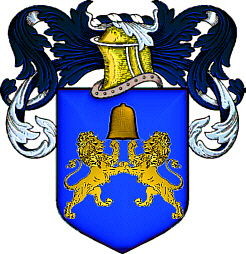 Saint-Jean with French Origins
Source: http://houseofnames.com
Coat of Arms: A blue shield with a bell held by two gold lions combatant.
Crest: Description not available
Origin: French
Spelling
variations of this family name include: Saint Jean, Jean, Geon, Jeans,
Jeane, Geans, Gen, Le Jean, Des Jeans, De La Geon, Saint-Jon,
Saint-Geans and many more.
First found in Languedoc, where the family was seated since ancient times.
Some of the first settlers of this family name or some of its variants were: Peter Gustavus Saint Jean settled in Philadelphia in 1848; Jean Antoine Jean settled in Louisiana in 1752; Pierre Armin Jean settled in Philadelphia in 1753.Most surnames have experienced slight spelling changes. A son may not chose to spell his name the same way that his father did. Many were errors, many deliberate. During the early development of the French language, a person usually gave his version, phonetically, to a scribe, a priest, or a recorder. Prefixes or suffixes varied. They were optional as they passed through the centuries, or were adopted by different branches to signify either a political or religious adherence. Hence, there a many spelling variations of the name Jean, including Saint Jean, Jean, Geon, Jeans, Jeane, Geans, Gen, Le Jean, Des Jeans, De La Geon, Saint-Jon, Saint-Geans and many more.
First found in Languedoc, where the family was seated since ancient times.

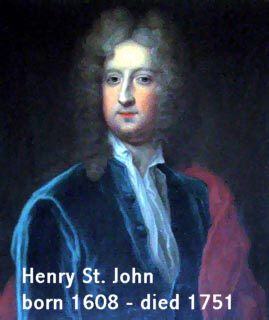 Henry St. John
Born: October 1608 at Battersea, Surrey
Viscount Bolingbroke
Died: December 1751 at Battersea, Surrey
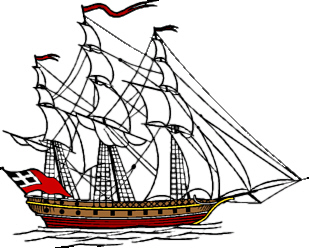 Ship's Log on the good ship, "Elizabeth and Anne" Ship's Log on the good ship, "Elizabeth and Anne"Sailed from London to Boston Captain: Roger Cooper/Cowper Eliza (Elizabeth) & Anne Date sailed: 17 April, 1635 Quoted text: "IN the ELIZA and ANE, sd RO. COOPER, for New England - THOMAS HEDHALL.........47 years. IN the ELIZABETH and ANN, ROGER COOPR., Mr. Theis pties. here under expressed are to be embarqued for New England, having taken the oath of allegeance and supremacie, and likewise brought certificates from the Ministers and Justices where their abidings were latlie of their conformitie to the discipline and orders of the Church of England, and that they are no subsidy men."
|
SENSION, Nicholas, Windsor, CT. He came from England in company with Joseph Alsoppe in a vessel called the 'Elizabeth and Ann', and was an early settler in Windsor. Other spellings noted are Senchion and St. John.
The most famous sodomy case in New England was that of Nicholas Sension
of Windsor, Connecticut. In 1677, Daniel Saxton, a citizen of Windsor,
Connecticut, charged Nicholas Sension with sodomy. Saxton was a
neighbor and
former employee of Sension. It was not until he was released from
his position at the Sension household that Saxton came forth with the
charge
against his former employer. Although he denied that coupling with
Sension, Saxton did bear witness to the fact that Sension had committed
sodomy with another servant, Nathaniel Pond.
Sension had moved to Windsor, Connecticut in 1640. In Windsor, Sension became a prosperous merchant and farmer. He married a local woman in 1645, and was soon recognized as a prominent member of the Windsor community. For three decades, Nicholas Sension lived what appeared to be a normal life, according to Puritan standards. However, while all seemed normal on the surface, something was amiss in the Nicholas Sension household. Thirty years before he was tried for sodomy, Sension had been approached by the town elders. On this occasion, in the late 1640s, William Phelps had contacted a Horskins in regards to Sension. Phelps was concerned about the fact that Sension had been making sexual advances towards his younger brothers, Samuel and Nathaniel Horskins It came to light in the 1677 trial that this matter was dealt with in private at the house of Henry Clark. Horskins and Clark, both representatives of Windsor to the General Court, confronted Sension. Sension explained that he had acquired his “sodomitical” ways while at school and promised to control himself. Believing that Sension was sincere and felt remorse, the matter was then dropped.
Since Saxton had not engaged in sexual activity with Sension, the court pursued the question of Sension’s relationship with Nathaniel Pond. A difficulty for the prosecution was the fact that Pond was killed two years earlier in Metacom’s War, and therefore the only witness, other than Sension, was dead. Another difficulty for the prosecution was the fact that as the trial progressed it began to center on whether the act of sodomy had actually occurred. During the course of the trial, several young men came forward to testify about Sension’s sexual tastes and practices.Nicholas was only convicted of attempted sodomy. He was
whipped, forced to stand in public with a noose around his neck, and briefly imprisoned.Nicholas
Sension was able to live within the community with only being
reprimanded twice in nearly forty years before being tried for sodomy.Sension had moved to Windsor, Connecticut in 1640. In Windsor, Sension became a prosperous merchant and farmer. He married a local woman in 1645, and was soon recognized as a prominent member of the Windsor community. For three decades, Nicholas Sension lived what appeared to be a normal life, according to Puritan standards. However, while all seemed normal on the surface, something was amiss in the Nicholas Sension household. Thirty years before he was tried for sodomy, Sension had been approached by the town elders. On this occasion, in the late 1640s, William Phelps had contacted a Horskins in regards to Sension. Phelps was concerned about the fact that Sension had been making sexual advances towards his younger brothers, Samuel and Nathaniel Horskins It came to light in the 1677 trial that this matter was dealt with in private at the house of Henry Clark. Horskins and Clark, both representatives of Windsor to the General Court, confronted Sension. Sension explained that he had acquired his “sodomitical” ways while at school and promised to control himself. Believing that Sension was sincere and felt remorse, the matter was then dropped.
Since Saxton had not engaged in sexual activity with Sension, the court pursued the question of Sension’s relationship with Nathaniel Pond. A difficulty for the prosecution was the fact that Pond was killed two years earlier in Metacom’s War, and therefore the only witness, other than Sension, was dead. Another difficulty for the prosecution was the fact that as the trial progressed it began to center on whether the act of sodomy had actually occurred. During the course of the trial, several young men came forward to testify about Sension’s sexual tastes and practices.Nicholas was only convicted of attempted sodomy. He was
MY QUESTION IS THIS:
Why is it that the Church saw fit to hang WOMEN for having premonition dreams and declared a witch deserving of hanging; while male sodomists only got a whipping?
ANSWER:
Because most of the Church fathers were also molestors and sodomists themselves - by now you recognize that age-old pattern of church fathers.
Why is it that the Church saw fit to hang WOMEN for having premonition dreams and declared a witch deserving of hanging; while male sodomists only got a whipping?
ANSWER:
Because most of the Church fathers were also molestors and sodomists themselves - by now you recognize that age-old pattern of church fathers.
MORE TO COME - THIS PAGE IS UNDER CONSTRUCTION