|
TRIBE
of REUBEN
FRANCE,
the CELTIC OF BRITTANY
 'Unstable
[unpredictable & diverse] as water, thou shalt not excel; because
thou went
up to thy father's bed and then defiledst thou it: he [Reuben] went up
to my
couch.' 'Unstable
[unpredictable & diverse] as water, thou shalt not excel; because
thou went
up to thy father's bed and then defiledst thou it: he [Reuben] went up
to my
couch.'
Who transforms as ice to steam?
Reuben. Who holds fast and then lets go without reason? Reuben. Who
appears
old, but yet is new? Reuben. Who is today here and tomorrow gone?
Reuben. If we
were speaking astrologically, we would be describing the unstable water
sign of
Cancer.
Reuben
once occupied the northern section of land that was ancient Gaul, in
modern
identification purposes, Reuben more specifically pertains to the
Celtic
peoples of France and especially Britanny. The name 'Gaul' refers to
the
ancient Celtic people who spoke a language known as Gaulish or Gallic.
Reuben
[France] was to lose his birthright status to Joseph [England].
Brittany, is
where Reuben resides in more modern times, which loses out in power and
strength to Joseph/England, as their destiny is so written.
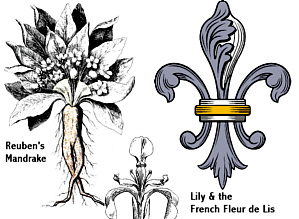
Reuben's
identifying symbol was the Mandrake. Reuben's interest was gathering a
plant
called mandrakes, of which he would gather for his mother, Leah, who
used the
mandrakes as a bartering item with her sister, Rachel. The plant may
have had a
narcotic effect, such as marajana, and perhaps Rachel had become
addicted to
them, for she traded her husband for the night for some of Reuben's
mandrakes.
Gen
30:14 -16 'And Reuben went in the days of wheat harvest, and found
mandrakes in
the field, and brought them unto his mother Leah. Then Rachel said to
Leah,
Give me, I pray thee, of thy son's mandrakes. And she said unto her, Is
it a
small matter that thou hast taken my husband? and wouldest thou take
away my
son's mandrakes also? And Rachel said, Therefore he [Jacob] shall lie
with thee
tonight for thy son's mandrakes. And Jacob came out of the field in the
evening, and Leah went out to meet him, and said, Thou must come in
unto me;
for surely I have hired thee with my son's mandrakes. And he lay with
her that
night.'
The
French Fleur de Lis symbolically replaces Reuben's mandrakes. France,
including
the province of Brittany, uses the fleur de lis as a logo. This symbol
is a
stylized design that resembles either an iris or a lily, and most
likely the
water lily or lotus, which was a ceremonial item in ancient Egypt. This
symbol
is commonly used in heraldry in many Israelite nations, but not as
predominantly as it is in France. The recent discovery of psychedelic
properties in the blue lotus [water lily] was probably known to the
Egyptians
and explains its role in ceremonial events.
Unpredictable and diverse is Reuben:
'France is known around the world as a very diverse country, of its
people,
architecture, and landscapes. About 50% of the French population claim
to have
a foreign background, which makes France one of the most diverse
countries in
the world.
Of
Reuben's birthright as firstborn son:
“And
Leah conceived, and bares a son, and she called his name Reuben: for
she said,
surely the Lord hath looked upon my affliction; now therefore my
husband will
love me.” Therefore the
name
Reuben means 'behold a son'. Leah was hoping that by presenting Reuben
to
Jacob, she would overcome her husband's preference for his second wife,
her
younger sister, Rachel.
“And
it came to pass, when Israel [Jacob] dwelt in that land, that Reuben
went and
laid with Bilhah his father's concubine: and Israel heard about it”.
Reuben
was the firstborn, albeit he defiled his father's bed by sleeping with
Jacob's
handmaiden wife, his rightful birthright was given to the sons of
Joseph,
Ephraim & Manasseh, therefore, the firstborn son of Jacob became
Ephraim.
As
sons of Jacob, the brothers experienced many conflicts and jealousies.
The
brothers once conspired to kill Joseph, since Jacob loved Joseph more
than he
obviously loved the others – 'And Reuben heard it, and he delivered him
[Joseph] out of his brother's hands and said, 'Let us not kill him.'
So
in this case, Reuben saved the life of his brother, Joseph, which
should have
redeemed his bad karma for sleeping with his father's chambermaid.
'Reuben, thou art my [Jacob's]
firstborn, my might, and the beginning of my strength, the Excellency
of
dignity, and the Excellency of power.'
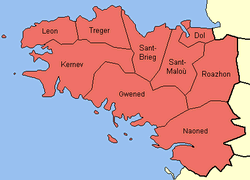
Brittany occupies a large peninsula
in the northwest of France, lying between the English Channel to the
north and
the Bay of Biscay to the south. Some people in Brittany complain about
the
current division of Brittany and would like to see Loire-Atlantique
joining the
region of Bretagne [modern name for Brittany] to reunify the original
boundaries of Brittany.
The
immigrant Britons gave this region in northern France its current name
and
contributed to the Breton language, Brezhoneg, a sister language to
Welsh and
Cornish. The French speaking peoples surrounding the region, gave the
name
'Bretagne' to the area where Britons [Celtic] settled while fleeing the
Anglo-Saxon invasion of Britannia, hence they gave the name 'Grande
Bretagne'
[Great Britain] to the island of the Britons. ‘Grand Brit’ in Hebrew
means
‘grand covenant’.
Brittany
is also famous for its megalithic monuments, which are scattered over
the
peninsula; the largest alignments are near Carnac. The purpose of these
monuments is still unknown, and many local people are reluctant to
entertain
speculation on the subject, however, we know – don’t we? They are the
‘stone
heaps’ that were set up by the Israelites. The Druids once knew their
importance, but of course Christian destroyers made sure the Druids
were
exterminated and forgotten. The words dolmen - from the words 'daol',
meaning
table, and 'maen' meaning stone = stone table; and 'menhir' means high
stone.
These words come from the Breton language, even though they are hardly
ever
used in Breton. The Bible records instruction to the Israelites to lay
up
stones along the way to be used as waymarks.
Reuben's
sinful conduct brought down upon him his dying father's malediction.
Although
Reuben was a part of the initial plot to kill and later enslave their
brother,
Joseph, it was Reuben who advises the others not to kill Joseph, and
later
points out that their troubles in Egypt were the consequence of the
plot. Later
he offers his own two sons as surety for the safety of Benjamin to
hopefully
end the famine, an offer Jacob refuses. After Jacob and his family went
down
into Egypt, no further mention is made of Reuben beyond what is
recorded in
Genesis, chapter 49. He was probably the
wisest and most compassionate of the brothers, but a bit unlucky.
As
firstborn, Reuben should have been the leader of his brothers,
therefore taking
responsibility for their collective actions, which he attempts to do
with
Joseph and Benjamin, but not completely effective enough to suit his
father.
Reuben's rights as 'first-born' were forever transferred to the
children of
Joseph.
|
 "Unstable
[unpredictable & diverse]
as water, thou shalt not excel; because thou wentest up to thy father's
bed; then defiledst thou it: he went up to my couch."
"Unstable
[unpredictable & diverse]
as water, thou shalt not excel; because thou wentest up to thy father's
bed; then defiledst thou it: he went up to my couch."