BENJAMIN THE DUTCH PEOPLE OF BELGIUM & NETHERLANDS |
|
|
|
|
The
TRIBE of BENJAMIN THE
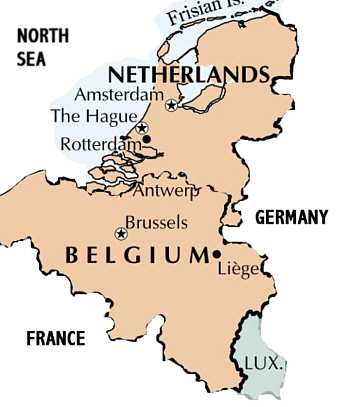
DUTCH PEOPLE & NATIONS BELGIUM [HOLLAND] NETHERLANDS Of Benjamin: 'This beloved tribe of the Lord shall dwell in safety by him; and the Lord shall cover him all the day long, and he [Benjamin] shall dwell between his [the Lord’s] shoulders.' Notice how Rachel seemed to have as much power in her words as did Jacob. Rachel named her son ‘Benoni’, meaning sorrow, and Jacob called him Benjamin. Benjamin did see quite a lot of sorrow. The name ‘Benjamin’ means ‘son of my right hand’. Could it be that a mother's dying words have more power than does the father's blessing. When looking at a map of Belgium and the Netherlands, we can see how these two small countries are positioned between the larger shoulders of France/Reuben and Germany/Dan, as if tucked in there intentionally. From the 16th century, until the Belgian revolution in 1830, many battles between European powers were fought in the area of Belgium, causing it to be dubbed the battlefield of Europe, and the cockpit of Europe. Little Belgium has certainly seen its conflicts, but then, so did the tribe of Benjamin. When identifying these tribal nations, it is the people who made the nations what they became, and the tribe itself is identified by these nations they represent. The capitol of Belgium, Brussels, is also the ‘capital’ of 25 European countries, and many diplomats and heads of state from Israelite countries worldwide meet in Brussels. Perhaps the ‘son of my right hand’ has come into effect. 'Benjamin shall ravin as a wolf: in the morning he shall devour the prey, and at night he shall divide the spoil.' Benjamin, as a ravenous 'WOLF', depicts accurately the Sea Wolf, which 'Dutchmen' would have encountered numerous times as Seafarers and Sea fishermen. The seawolf is a large type of catfish that can reach five feet in length. Both jaws are armed in front with strong conical teeth and on each side with two series of large tubular molars, a biserial band of similar molars occupy the middle of the palate. With these teeth, the seawolf is able to crush the hard carapaces or shells of the crustaceans and mollusks, on which it feeds. In Iceland, these sea creatures are called the 'stone biters'. When one set of teeth have ground down to become ineffective, the seawolf grows another set of teeth – we should be so lucky. The seawolf could very easily be categorized as ravenous. Seawolves are commonly found along the coasts of Scandinavia, North Britain, Iceland, and Greenland. Source: en.wikpedia. Before settling down in the Netherlands, the tribe of Benjamin fished the northern seas. The Old Norse word 'Sjolfr', pronounced 'saewulf', means 'seawolf'. The first king of Israel, Saul, was a Benjaminite. At one time, many from the tribe of Benjamin were found within the communities of Judah, as were the Levites. As per biblical reference, we glean the following facts about Rachel's second son, Benjamin: * Benjamin was
doted over
by his half brother, Reuben - [Brittany of northern France] * Jacob's
youngest son of
the twelve * The connection with 'Belial' carries over in the Celtic group called Belgae. The name Belgium comes from the word Belgae. Belgium is a mix of Belgae Celtic and Germanic peoples.
The Benjaminites left Palestine because of a civil war among the tribal members of all Israelites. The conflict was created because the Benjaminites became allied with the 'Sons of Belial' and, consequently, would not impose Israelite laws and customs upon the Belial. This war is covered in Judges chapter 21 in the Bible. The result was that most of the Benjaminites either left Palestine on their own accord, or were expelled by the victorious eleven tribes.
#1100 BELIAL, according to the Hebrew definition: bliya`al bel-e-yah'-al from #1097; without profit, worthlessness; by extension, destruction, wickedness, Belial, evil, naughty, ungodly [men], wicked. #1097 bliy bel-ee' from #1086; properly, failure, i.e. nothing or destruction; usually [with preposition] without, not yet, because not, as long as, etc, corruption, ig[norantly], for lack of, so that no, none, not, un[awares], without. #1086 balah baw-law' a primitive root; to fail; by implication to wear out, decay [causatively, consume, spend], consume, enjoy long, become [make, wax] old, spend, waste. Worthless and destructive – this is what I claim for ALL religions, so in essence, all religions are ‘Belial’ religions. Case closed. However, it is possible that the term 'Sons of Belial' was a derogatory term to describe certain people that the Israelites didn't agree with, or a group of people strongly disliked. Belial means partaking or associating with people who demonstrate less than desirable characteristics. With the eleven tribes at odds with Benjamin, it is possible this identification of 'Belial' stayed with Benjaminite tribal members for a long period of time. The expression Belial probably simply means a lawless person. Had this term 'Belial' transferred to the Celtic people called, 'Belgae'? Perhaps not, as one of the sons of Benjamin was named Bela. It is my belief that Belgium was named after this son. Julius Caesar divided the people of Gaul, at the time of his conquests [58-51 BCE], into three broad groups: the Aquitani, Galli [who called themselves Celtae], and Belgae, all of whom had their own customs and languages. The Celtic people are represented by Leah's sons, not Rachel's sons. Dan intervened between the Benjaminites and the Philistines, which may be the reason they are found close to Dan's tribe in modern times, Denmark and Germany. The history of Benjamin's tribe contains a sad record of a desolating civil war in which they were engaged with the other eleven tribes. By it they were nearly exterminated. The sons of Benjamin after their families: of Bela, the family of the Belaites: of Ashbel, the family of the Ashbelites, of Ahiram, the family of the Ahiramites. Benjamin's birth took place on the road between Bethel and Ephrath, which is identified with Bethlehem [Genesis 35:19]. His mother, Rachel, died in childbirth, and with her last breath named him Ben-oni [['son of my pain'], an ill-omened name which was changed by his father to Binyamin, son of my right hand. The tribe of Benjamin, at the Exodus, was the smallest tribe next to Manasseh, which was split off from Joseph [Numbers 1:34-1:37; Psalms 68:27]. At the entrance into Canaan, the Benjaminites counted 45,600 warriors. It has been inferred by some from the words of Jacob [Genesis 49:27] that the figure of a wolf was on the tribal standard, but this should probably be a seawolf. A close alliance formed between Benjamin's tribe and Judah during the time of David. After the Exile, these two tribes formed the great body of the southern kingdom of Judah, led in the territorial direction of the tribe of Benjamin. It was called by Jeremiah, 'the high gate of Benjamin', also 'the gate of the children of the people.' [Jeremiah 17:19].
|